Wednesday, December 21, 2011

Pedigree + Family Group Record + Index: a dynamite combination

The nitty-gritty of genealogy is gathering information. Charting Companion offers great tools to get the job done:
  • The classic Pedigree chart
  • Matching Family Group Record
  • A comprehensive Index
Five-generation Pedigree


The Pedigree is a rigid, fixed-format chart that differs from the Ancestor in that blank spaces are reserved for missing ancestors, instead of compacting the chart.


Index for Pedigree Charts


An Index is a nice touch to quickly locate people, if you have a lot of Pedigree charts.


Family Group Record


The Family Group Record makes a great worksheet for family and relatives to fill in missing information, or correct errors. Easy to hand out a family reunions.

All three of these charts are generated automatically when you select the "Pedigree Chart" option.

Charts for Genetics

The Charting Companion Descendant and Outline Descendant charts provide some interesting genetic options: Y-chromosome and Mitochondrial. Both are useful for tracking the inheritance of genetic traits, passed on from ancestor to descendant.

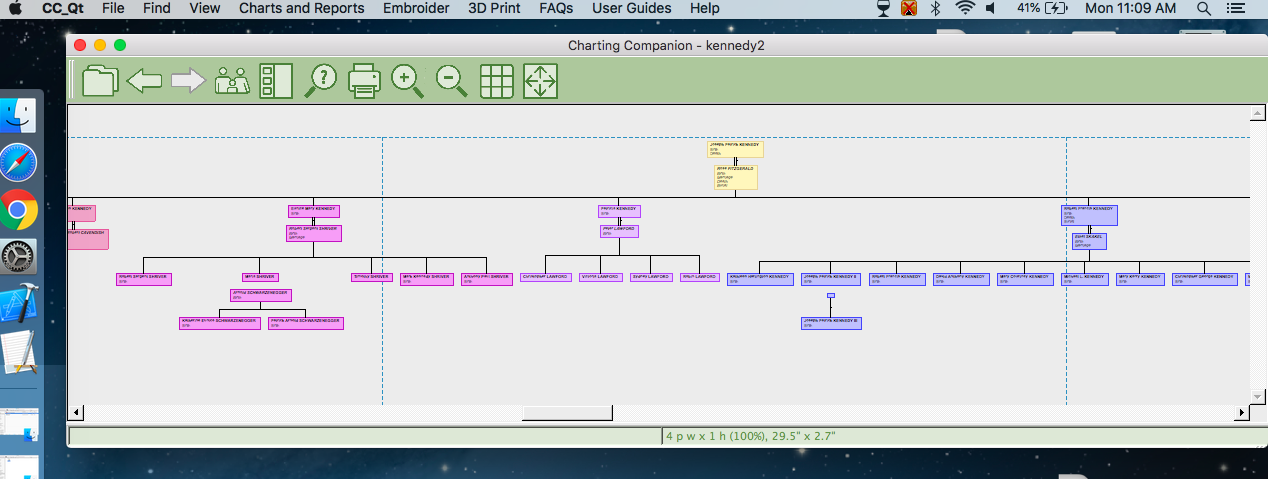
Here is a chart of all the members of a family. The males are colored blue, and the females pink:
All the descendants
The Y-chromosome option shows all the male descendants who inherit this chromosome which determines gender. The Y chromosome can be used to determine paternity.
Y-chromosome - male descendants

The Mitochondrial option shows the female descendants who pass on the mitochondrial DNA to their daughters, and the sons who inherit, but do not pass it on:
Mitochondrial - female descendants (transmit), male (carry)
Unlike the other chromosomes that can recombine, The Y-DNA and Mitochondrial both pass down unchanged except for mutations, which makes them valuable for research and genealogical identification.

Tell the story of your family genetically!

The "Outline Descendant": compact and complete

The Outline Descendant is a unique report that lists a person's descendants, indenting for each generation.

Charting Companion's Outline Descendant has a special feature: an optional recap header.
Outline Descendant with handy "recap" feature
How often have you waded through page after page of a Descendant report, only to lose track of where you are in the pedigree?

Charting Companion includes a recap at the top of each page, a summary of the connection between the patriarch and the current person, so you can "keep your bearings" and know where you are in the tree.

The Outline Descendant includes a convenient index at the end, so the reader can quickly find persons of interest.

Telling the story of your family in a Book

Charting Companion is the only program[1] that can create a book from your genealogy data, and output it in a format that is truly compatible with your word processor: MS Word, WordPerfect, Open Office, etc. There are several benefits to this approach.
First page of a Descendant Book (aka "Register")
You can fine-tune the font type, font size, margins, page layout, etc. to suit your tastes. You can add photos to the book, in addition to the ones that Charting Companion automatically includes for you.

Charting Companion embeds special indexing codes throughout the book. These codes are unseen by the reader, but they guide the word processor into creating an automatic index at the end of the book. This is important because, as you change the format of the book, the page numbers will change and will need to be re-calculated. The word processor does this simply and quickly, giving you the option of a single- double- or multiple column index.
Three-column index with multiple page references for each person
The index includes years of birth and death, to differentiate between all those "John Smiths". Women are indexed under both their maiden and married names. The index can be configured so that surnames are only shown once; only the given names appear of all the people with the same surname. This improves legibility, and reduces the number of pages.

Charting Companion also embeds special "footnote" codes for your source citations. This provides maximum flexibility for the word processor to place the footnotes at the bottom of the page (or the end of the book), a complex balancing of text and footnotes that the word processor will perform for you.

If you want to take your family history to a printing company to be published as a bound book, your printer will need the special format created by Charting Companion.
-------------------------------------------
[1] Other programs can output RTF, but do not include an index and footnote codes which are required if you want flexibility.

Bevels and gradients - how to spice up your charts

The Charting Companion programs offer three flavors of color - regular, gradient and bevel.

The gradient option creates a nice, smooth blend that softens the color, as in this example:

Gradient color

The bevel option draws a beveled edge around each square, and adds a nice textured gradient in the center.

Beveled color

Both options provide eye-catching enhancements that are a colorful way of telling the story of your family.